Life Stories- Hideriotes and Australia
Migrant Profile: Grigorios Kambas
Grigoris Kambas (1916- )
Memories from the Albanian Front (1940-41)
Narrated by Grigorios Kambas
to Vasilios Vasilas
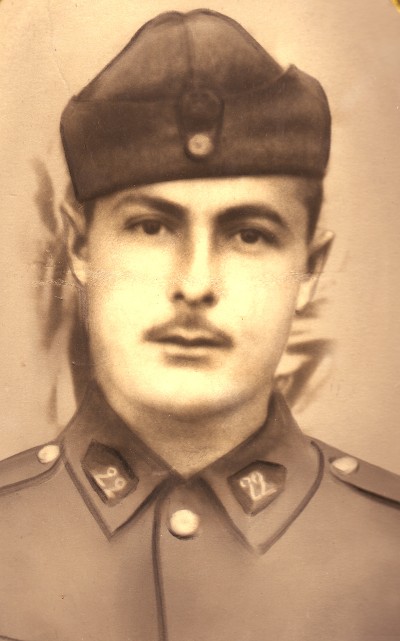
Above: A portrait taken during National Service.
During my National Service, I served in the Infantry; in the Loho Dioikiseos I was the bugler. I was trained by an instructor how to use the bugle- whether to quicken and slow the revelry. The most difficult part of my daily routine, I suppose, was that I had to be the first to wake up, as I had to wake everyone up. During the day, I would have to walk around with the Captain, and I would await his orders what to signal.
We were stationed in Limnos when the Treaty of Mudros was signed between Greece and Turkey signed (1938). While I was in Limnos, I had applied to be transferred to Mytilene, as my father, Mihalis, was ill- my mother, Maria, had already passed away; however, we were sent to Komotini, as there had arisen some problems on the Greek-Bulgarian border. Wars in the Balkans were so frequent back then; with all the tension at this time, you would think we were probably due for another war. This explains why we were always on alert.
When we were discharged in early 1940, the Second World War had begun; whether it was wishful thinking or ignorance, many of my peers and I did not believe Italy would attack Greece and bring us into the War. I returned to Hidera- to look after my ill father- and worked on our fields and sheep. A difficult life...
Yet, Italy’s attack on Greece dramatically changed everything; the nation was mobilised and we quickly found ourselves back in the army. However, this time…it was war. The Mytileneans were sent to Alexandroupolis’ base, where I was placed in the 22 Division we were given backpack mules, food, large pots for cooking. By the time we reached the foothills of the Pindus mountains, the Italians had already been pushed back into Albania. There were these thick forests- so thick- not even mules could pass through. Our officers selected a place for us to stop, where we were placed in different regiments. Our regiment was immediately sent to the front
On our way to the frontline, our Major was meant to stop at a certain place. We were greeted by some Albanians who assured us there were no Italians in their village. Without any fear, we passed through their village singing patriotic songs. Our sense of self-assurance was shattered when there was sudden gunfire and explosions- of grenades. We panicked, as we had no idea where the enemy was positioned. In the instantaneous chaos, we stampeded forward through the street, trying to escape. We rapidly realised the Italian fire was coming from inside the houses. To compound our worst fears, the Greek artillery began bombarding the village from their elevated position. What an awful situation! Our sergeant ordered to move forward in threes; I remember one threesome disappeared before our eyes, when a doorway opened up and they were dragged in. The shrill of approaching shells brought forth these deafening explosions and then dark smoke engulfed the area. The artillery ravaged our unit. All we could do was hide behind some rocks (near the edge of the village) and hope for the best. In small groups, the Italians retreated; many of these groups even passed us. However, the ambush had sapped us of any strength; we were too demoralised (and too few) to start firing upon them. How many of them were there? Where would we find support? The dangers outweighed the opportunities for heroism, and we watched leave the village.
After this baptism of fire, it was straight to the Front. Along the Front, there were posts which consisted of thirteen soldiers. We dug a trench, placed planks of wood across its base (for us to avoid touching the ground) and erected a camouflaged tent to cover us from the rain. In front of us, we also erected our wires; we also hung tins all over them- to warn us if any of the enemy tried a surprise attack. Behind our line was the rest of our unit. While we mostly ate dry food, they had the large pots to cook with. There were some times we fortunately had something different; for example pasta. At night, we would stare out at the Italian line- into the vast nothingness of night. I suppose it was the same for them too. It is no wonder there were constant mortar attacks. During these mortar attacks, our heart beat skipped several beats from sheer fear. However, I thought everything was temporary; it was possible that our forces had the momentum and we were awaiting the next order to move forward. Every time we came across Italian wires, we noticed they were thicker and more elaborate. Their trenches were also much better than ours; they had even cemented some of their walls (while ours were just dirt).
With the winter came the snow, the snow. I will never forget that cold. Of the thirteen of us, I was one of the few that endured the torturous cold. I do not know where we found it, but we also had cognac from time to time- which kept you warm. I used to rub my hands with it too. We had a lot of comings and goings; it was the battle with frost bite that ironically brought about most of our casualties. With an attack, the inexperienced privates would dive to the bottom of the trench- and into the water. Having soaked uniforms exposed them to severe colds and, in their desperate attempts to warm themselves, frostbite. I made sure I never fell into the water. In the village of Bogradetz, I was fortunate that I had found a sheep skin cover for feet.
We had made a brief stop in Bogradetz to rest; I was with two others. After starting a fire to cook some chestnuts, we came face-to-face with half-a-dozen Italians. It was such a surreal experience! It would have natural to leap for our rifles and begin firing, yet we simply froze in the strange situation. In my observation, they were similar to us. Like us, they were probably farmers, left their families behind and had hopes of trying to survive this dreaded war. After this momentary pause, they bolted. We followed suit, as we did not if there others with them. As for our chestnuts, we were happy to eat them raw.
It was not the only time we came across Italians. Another time, we had run out of water and our sergeant knew of a place where we could find a freshwater stream. Three of us followed him to this wild place- with abrupt mountain slopes. However, when we reached the stream, there were already a dozen Italians filling up their water bottles. We found ourselves face-to-face with them. Our sergeant raised his arms. He turned to us and said, “If they take me, start firing,” before approaching them. He could speak a little Italian, and tried to make them understand, “In the same way, you’re loved ones are waiting for you in Rome, our loved ones are waiting for us in Athens. All we want is water…” All this time, we had our rifles ready for any trouble, but nothing happened. They filled their water bottles, so did we. We went back to border point and did not tell anyone about our encounter; they probably did not say anything to their superiors too.
Continued: Part 2